
Understanding sumo
A practical reader for the rest of the site. Skim it; the terms you'll see in tooltips elsewhere (kachi-koshi, kinboshi, ōzeki) all come from here.
The basho

Professional sumo runs six basho a year - January (Hatsu), March (Haru), May (Natsu), July (Nagoya), September (Aki) and November (Kyūshū). Each lasts fifteen days, opening on a Sunday and closing on the next Sunday-but-one - that final day is senshuraku.
Every wrestler in the top two divisions fights one bout per day, fifteen total. Lower divisions wrestle seven bouts spread across the fortnight. The wrestler with the most wins in each division at the end of the fifteen days wins the yūshō for that division.
The dohyō
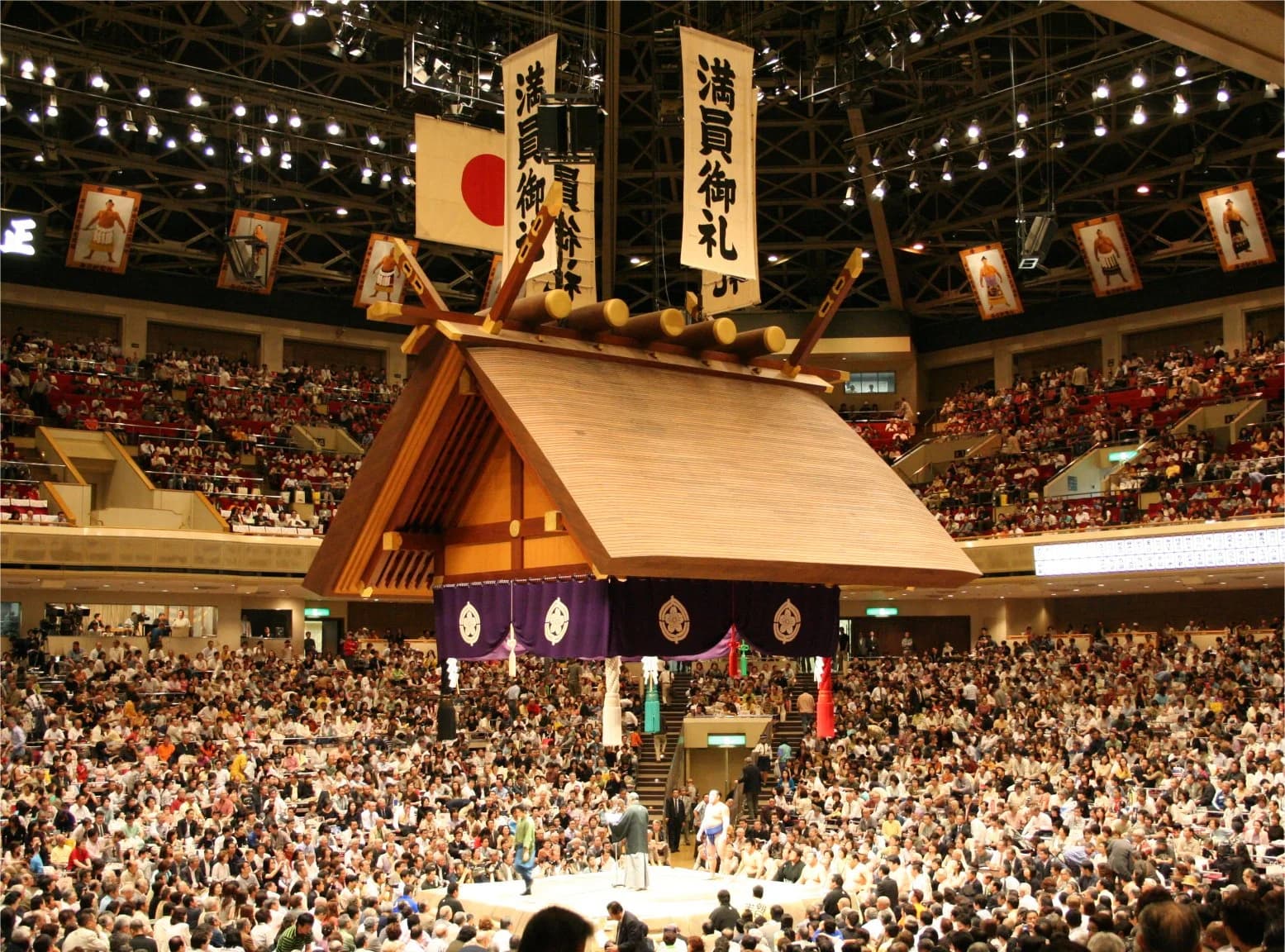
The ring - the dohyō - is a 4.55-metre circle of packed clay surrounded by a square base, with rice-straw bales (tawara) forming the boundary. A canopy modelled on Shintō shrine architecture - the tsuriyane - hangs above, with coloured tassels at each corner marking the four cardinal directions and their seasonal guardians.
Two parallel white lines bisect the ring at the centre - the shikiri lines, where the rikishi crouch before the charge. Lose your balance, step out, or touch the clay with anything other than the soles of your feet, and you lose.
- Tawara
- - woven rice-straw bales forming the ring boundary
- Shikiri lines
- - two parallel marks where rikishi crouch before the tachiai
- Diameter
- - 4.55 m, on a raised square earth platform
- East side
- - slightly senior to West at the same rank
- Tsuriyane
- - the Shintō-shrine canopy suspended above the ring
- Salt circle
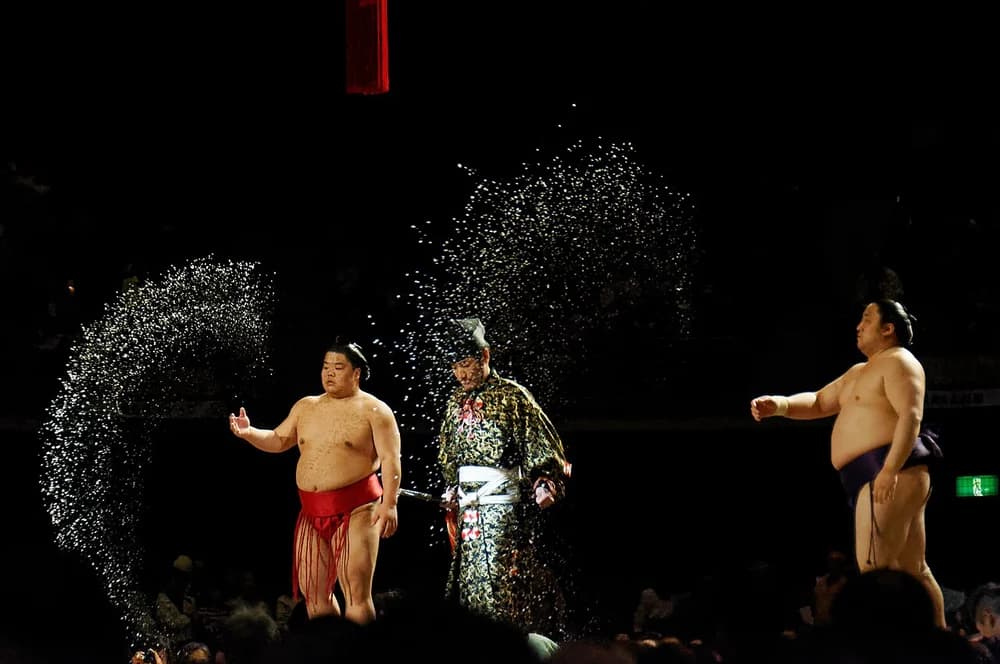
- - where rikishi throw shio to purify the clay
Ranks and divisions
San'yaku· the top 4 ranks~2 each▾
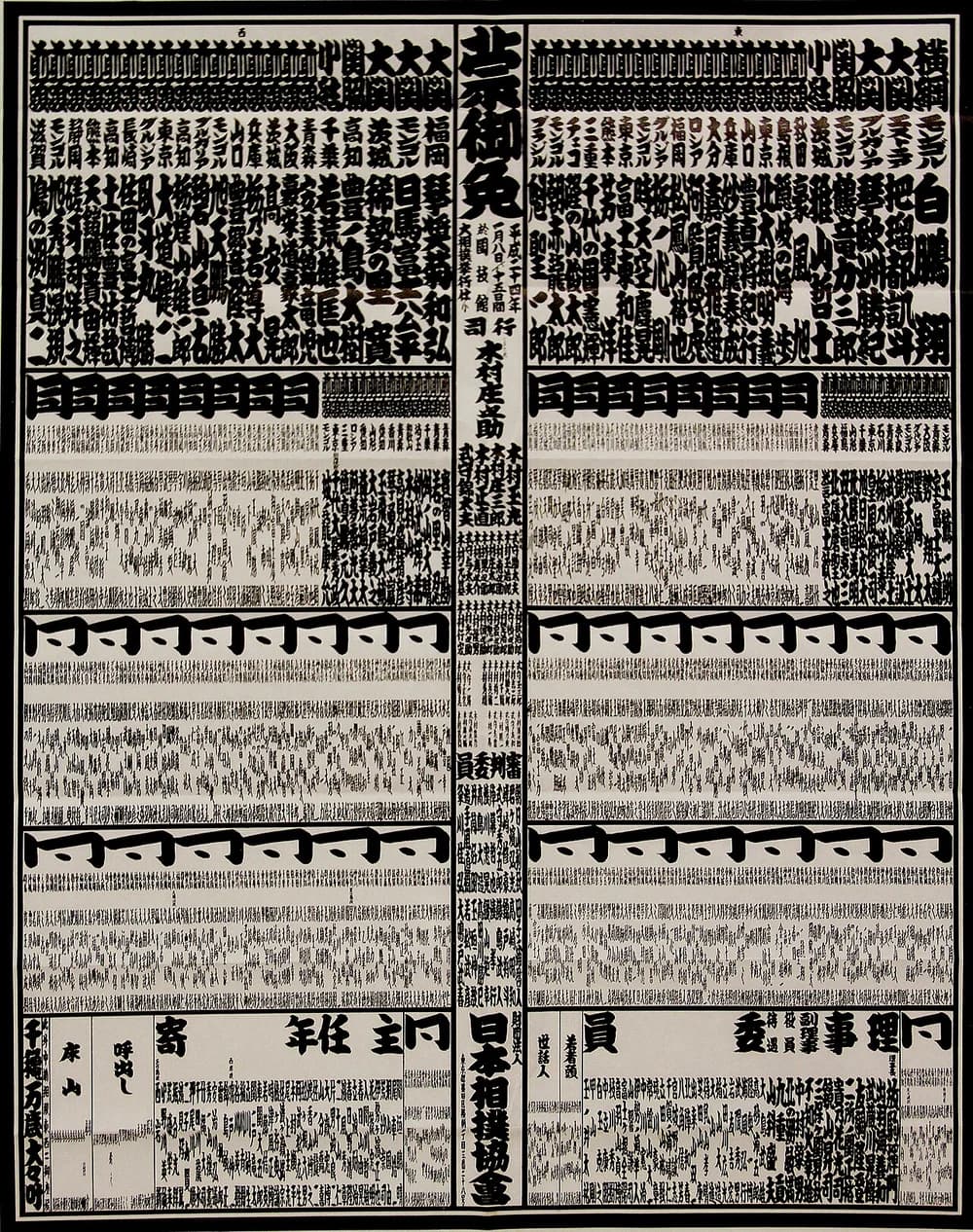
Every wrestler holds a rank on the banzuke - the ranking sheet redrawn before every basho. There are six divisions; the top two (juryo and makuuchi) are sekitori: salaried, allowed silk mawashi, given their own attendants. Everyone below trains and serves the sekitori while competing in fewer bouts.
Within the top division, the four highest ranks - yokozuna, ozeki, sekiwake, komusubi - are collectively the san'yaku. Below them, the maegashira are numbered M1 (highest) down to M17 or so. Each rank has an East-side and West-side slot; East is slightly senior at the same number.
A bout
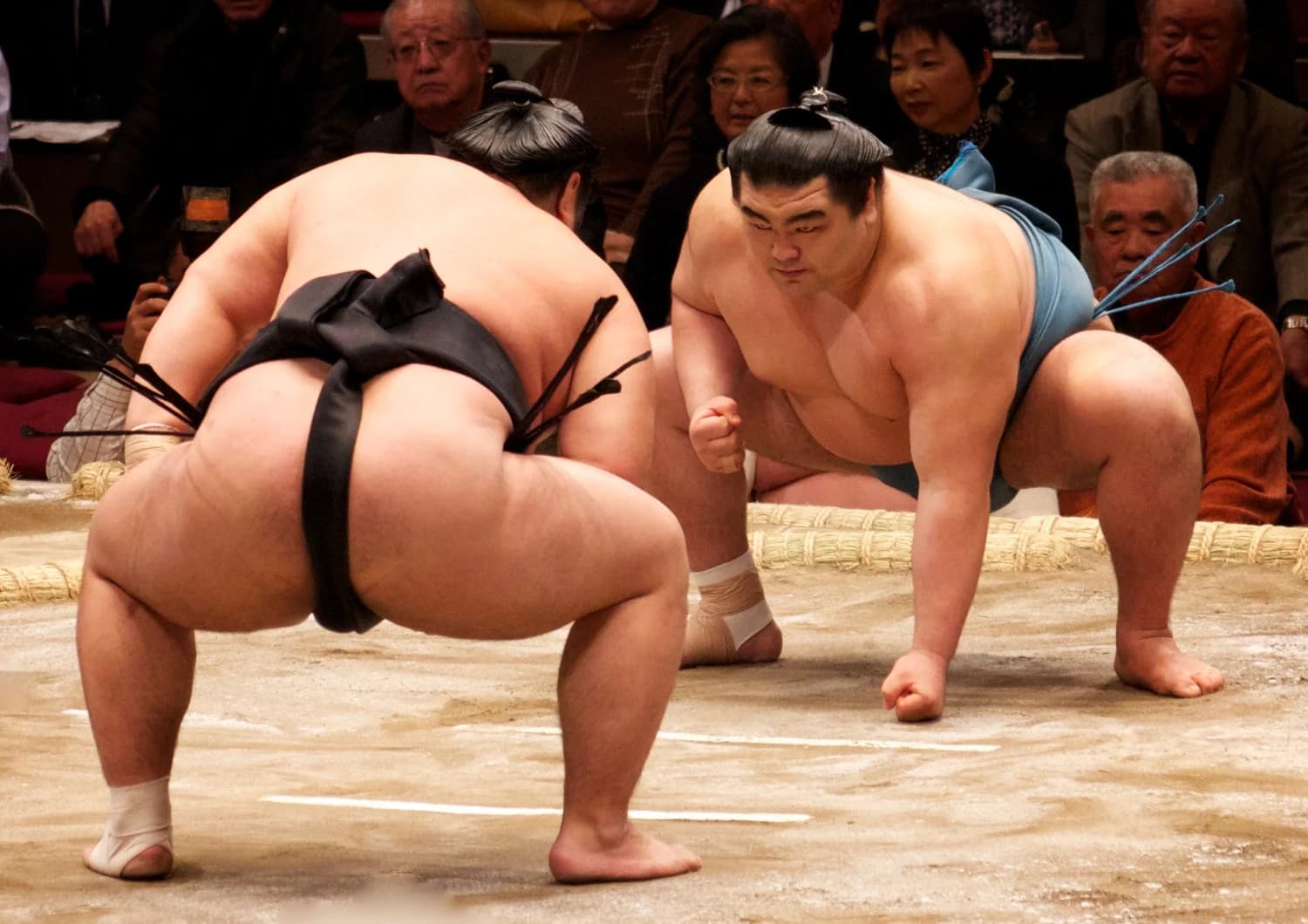
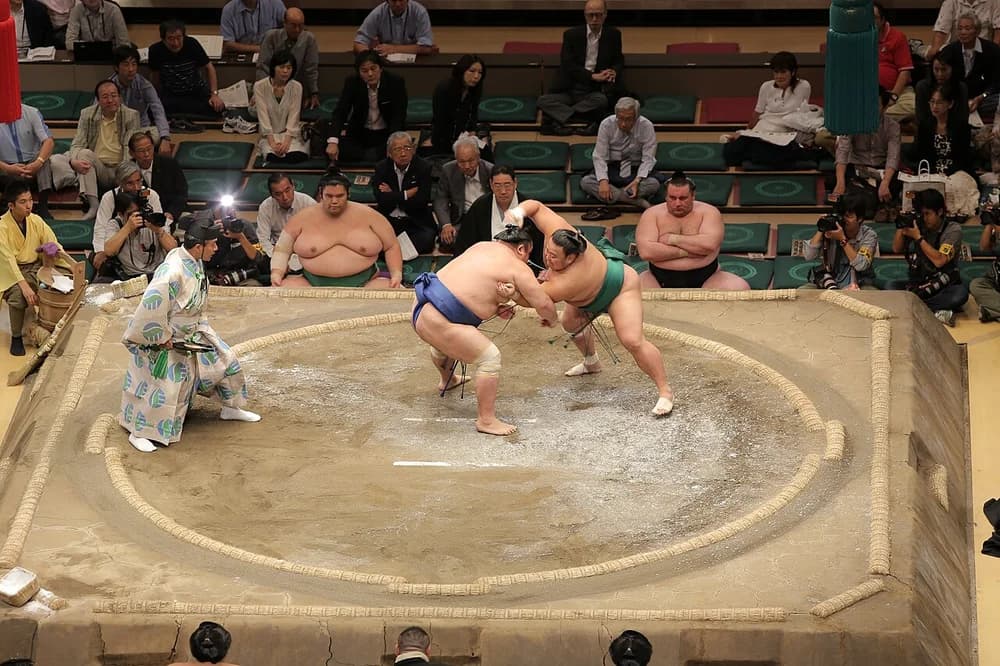
The fight begins with the tachiai - the simultaneous low charge from a three-point stance. Both rikishi must touch down with both hands at the same time for the bout to start. Get this wrong and the gyōji calls a do-over.
From the tachiai, anything is allowed except: closed-fist striking, hair-pulling, poking eyes, grabbing the throat, kicking the chest or stomach, and grabbing the inside of the mawashi. No time limit; bouts that last more than four minutes (extremely rare) get a short break.
A win is registered when your opponent: steps or falls outside the ring, touches the clay with anything other than feet, or commits one of the prohibited acts. The referee - the gyoji - names the winning technique (the kimarite) from a list of 82 official moves. Frontal force-out (yorikiri) and frontal push-out (oshidashi) account for over half of professional bouts; the rest range from common throws to once-a-decade rarities.
A sidestep at the tachiai - the henka - is legal but considered poor form at higher ranks. Doing it as a yokozuna is the sumo equivalent of winning a chess game on the clock against a beginner: technically a win, socially a problem.
Promotion and demotion
Outcome of a basho is binary at every level: kachi-koshi (more wins than losses - 8 or more in a 15-day basho, 4 or more in a 7-bout division) means you'll be promoted or hold rank. make-koshi (the opposite) means demotion.
Promotion gets harder near the top. To reach ozeki, the convention is roughly 33 wins across three consecutive basho at sekiwake or komusubi. Yokozuna promotion is rarer and not formulaic - it requires two consecutive yūshō (or equivalent) as ōzeki, plus a unanimous recommendation by the Yokozuna Deliberation Council, plus consent of the Japan Sumo Association board. There's an extra constraint: once you're a yokozuna you're never demoted. You're expected to retire when you can no longer fight like one.
An ōzeki who make-koshis is called kadoban for the following basho - one more losing record means demotion. They can win the rank back immediately by going 10+ wins on the next basho.
Prizes and purses
The yūshō is the championship - most wins after fifteen days. The makuuchi winner lifts the silver Emperor's Cup- about 29 kg, in continuous use since 1925 - along with a parade of secondary trophies (Prime Minister's Cup, foreign embassy cups, sponsor cups; Hakuhō famously joked about needing a forklift). The cash prize is about ¥10 million. Each lower division has its own yūshō trophy and a proportionally smaller purse.
Three further prizes - the sansho- recognise standout performances among top-division rikishi who finish kachi-koshi but don't win the yūshō. The shukun-sho goes to outstanding performance (often beating yokozuna or ōzeki); the kanto-sho to fighting spirit (typically double-digit wins with unrelenting effort); the gino-sho to technique (rare or beautifully-executed kimarite). Each is worth roughly ¥2 million.
Special to maegashira: a kinboshi, literally "gold star", is awarded to any maegashira who beats a yokozuna in a regulation bout. Each one earns a permanent ¥40,000-per-basho raise - paid for the rest of the wrestler's career, on top of base salary. A maegashira with ten lifetime kinboshi earns ¥400,000 extra per basho, forever. They are remembered and counted.
Outside the championship, money flows in three more channels. Kensho-kin are the sponsored-bout envelopes - companies pay around ¥70K to hang a banner before a popular bout, the banners are paraded around the ring before the wrestlers charge, and roughly ¥30Kof that face value ends up in the winner's hand after the JSA takes its cut (taxes plus a hold-back paid out at retirement). Star yokozuna routinely walk off with twenty or thirty envelopes in a single day. Mochikyū-kin is a career-cumulative win bonus that ratchets up with every victory and pays out per basho - quietly substantial for a long career.
Finally, base salary - but only above the rank cliff. Sekitori (jūryō and makuuchi) draw a monthly salary that scales with rank, from around¥1.1M at jūryō up to ¥3.0M for a yokozuna. Below jūryō, wrestlers receive only modest per-basho stipends (~¥150K) - which is why promotion to jūryō is the single biggest financial milestone in a sumo career.
The other people in the ring
The referee. Wears formal kimono, decides the kimarite, can be overruled. Senior gyōji carry a sword that signals their willingness to commit ritual suicide if a call is reversed (this is symbolic - they no longer actually do).
The five judges in formal kimono ringside. Can convene at any time to discuss a close call (mono-ii) and overturn the gyōji's decision or call a rematch (torinaoshi).
The announcer who calls each pair into the ring in a long sing-song chant. They also build the dohyō by hand before each basho and beat the taiko drum to open and close each day.
Specialist hairdressers responsible for the rikishi's chonmage (topknot). Sekitori wear the oichō-mage - the gingko-leaf topknot - only for bouts.
Stablemasters. Retired top-division rikishi who buy or inherit one of 105 toshiyori kabu (elder shares) and run a heya, training the next generation.
Rituals
Sumo is a Shintō ritual that became a sport. Most of what you'll see between bouts is ceremonial: